
Custom Website vs Website Builder: What Should a Business Choose?
Website builders can be efficient for straightforward requirements, while custom development offers greater control over brand, functionality, integrations and growth. The right choice depends on what the website must do.
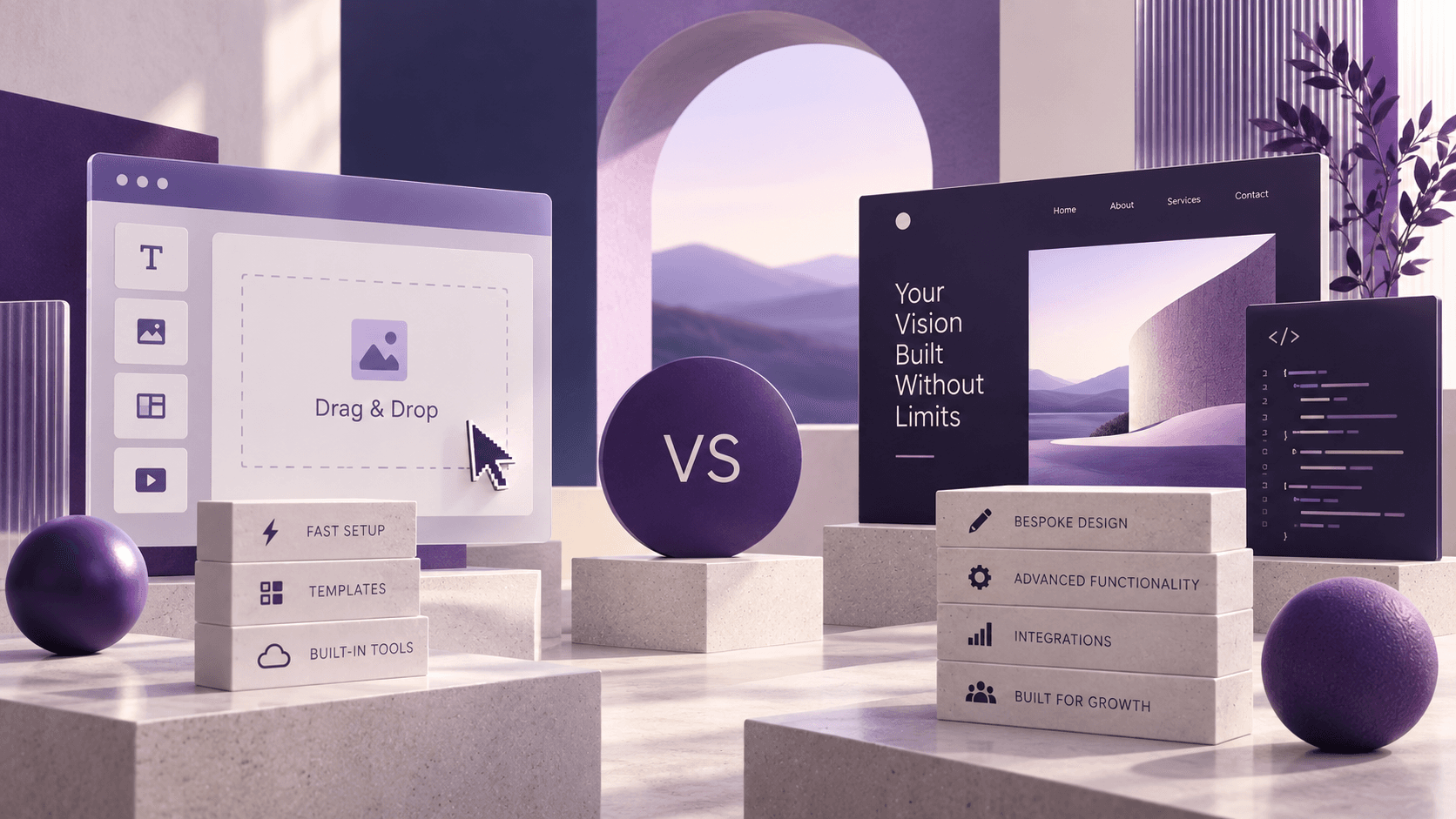
Businesses planning a new website often face an early choice: use a website builder or invest in a custom website.
Website builders have made it possible to launch attractive pages quickly, often with limited technical knowledge. Custom development offers greater control over the design, functionality and way the website supports the business. Neither option is automatically better for every organisation.
The right choice depends on what the website needs to achieve, how distinctive the experience should be and how much complexity or growth it must support.
This comparison explains the practical differences so you can choose an approach based on business needs rather than assumptions.
What is a website builder?
A website builder is a platform that provides hosting, templates and visual tools for creating pages within an existing system. Users usually select a theme, customise the content and add features through built-in tools or extensions.
This approach reduces the technical work required to launch a straightforward website. It can be suitable for a small organisation, a temporary campaign, an early-stage idea or a business whose needs fit comfortably within the platform’s standard features.
However, the business is working within the platform’s design system, functionality and commercial terms. This can become more noticeable as requirements become more specialised.
What is a custom website?
A custom website is planned and designed around a particular organisation, audience and set of objectives.
Custom does not necessarily mean that every technical component is built from nothing. A professional team may use a reliable content management system, framework or established services behind the scenes. The difference is that the structure, interface and implementation are shaped around the project rather than dictated by a pre-designed theme.
This approach is most valuable when the website needs to communicate a distinctive brand, manage complex content, support specialised journeys or connect closely with business systems.
Design and brand expression
Website builders offer a quick starting point through templates. Good templates can produce a polished result when the content and brand fit the available layouts.
The limitation is that many businesses begin from the same visual structures. Significant customisation may be possible, but it can require workarounds or still retain the underlying character of the template.
A custom website begins with the brand and content. The layout, typography, components and interactions can be designed to create a more distinctive experience. This is particularly useful when credibility, positioning and brand recognition influence the buying decision.
Choose based on the level of differentiation the business needs. A standard structure may be entirely appropriate for a simple informational website. A business competing on expertise, experience or a distinctive offer may benefit more from custom design.
Functionality and integrations
Website builders are effective when the required functionality is already supported. Common forms, simple online shops, appointment tools and newsletter connections may be available with little setup.
Problems arise when the desired process does not fit the available feature. The business may need several extensions, compromise its workflow or rely on manual steps between systems.
Custom development provides greater flexibility for specialised functionality and integrations. The website can be designed around a particular booking process, content model, directory, customer area or connection to internal software.
This does not mean every custom feature is justified. Bespoke functionality takes more time to specify, test and maintain. It should solve a real operational or customer problem.
Search engine optimisation
Both website builders and custom websites can be visible in search. SEO performance does not come from the label attached to the platform alone.
Search visibility depends on useful content, clear structure, crawlability, appropriate metadata, internal linking, mobile usability, performance and the authority the website develops over time.
Many builders provide the basic controls needed for titles, descriptions and page URLs. A custom build can offer more control over technical implementation, structured content, templates and performance. That control becomes valuable for larger websites, competitive searches or complex content, but only when it is used properly.
Whichever route you choose, SEO should be planned before launch rather than treated as a plugin or setting that automatically produces rankings.
Performance and user experience
The speed of either option depends on how it is built.
A simple website-builder site can perform well. It can also become slow when it uses a heavy theme, oversized images, numerous applications or effects that are not carefully managed.
A custom website allows the development team to control more of the code, assets and loading behaviour. It can be optimised around the actual content and features rather than carrying everything included in a general-purpose theme.
Performance should be assessed in the context of the complete user experience. Fast loading, clear navigation, readable content and reliable interaction all matter more than visual novelty.
Content management and ease of use
Website builders are designed to make routine editing accessible. For small teams that want to change text, images and pages directly, this simplicity can be a major advantage.
A custom website can also provide an easy editing experience, but the administrative interface needs to be planned. A well-designed content management system gives staff clear fields and reusable components without allowing accidental changes to the entire layout.
Ask to see how common updates will be performed. The most flexible editing tool is not always the easiest to govern, especially when several people publish content.
Scalability and future change
Consider not only what the website needs at launch, but what is reasonably likely to change.
A builder can support growth as long as the platform offers the required features and capacity. Moving beyond those boundaries may require replacing parts of the website or migrating to another system.
A custom solution can be structured for planned expansion, such as new content types, markets, languages or integrations. It is not infinitely flexible, and future changes will still require development, but important requirements can be anticipated in the architecture.
Avoid paying for hypothetical complexity. Plan for credible growth rather than every feature the business might one day consider.
Ownership and portability
With a hosted website builder, the website operates within the provider’s platform. The business normally owns its content and domain, but the theme, functionality and page construction may not be portable in the same form.
If you leave the platform, some content may be exportable while the website itself needs to be rebuilt.
Ownership arrangements for custom websites vary. Before starting, confirm who owns the design, code, content, domain and accounts, and whether another competent supplier could maintain the website if required.
Neither model removes dependency completely. The important point is to understand where that dependency exists and whether it is acceptable for the business.
Security and maintenance
Hosted builders normally manage the underlying infrastructure, core updates and much of the platform security. This reduces the technical responsibility placed on the business, although account security, permissions, content and third-party applications still need attention.
A custom website may require a clearer maintenance arrangement for hosting, updates, backups, monitoring and compatibility. The level of responsibility depends on the technology and provider.
Ask what is included after launch. A professional website requires ongoing care regardless of how it was built.
Initial cost and long-term cost
A website builder usually has a lower barrier to entry. It can reduce the amount of discovery, design and development required, especially when the business prepares the content itself.
Custom websites require more upfront work because the team is defining and creating a solution for a particular organisation.
The longer-term comparison is less simple. Builder subscriptions, premium applications, transaction fees and workarounds can accumulate. Custom websites also have hosting, maintenance and future development costs.
Compare the total cost in relation to what the website contributes. A low-cost website that cannot support the required customer journey may be poor value, while a complex custom build for a simple need may be unnecessary.
When a website builder may be the right choice
A website builder may suit your business if:
- the website is small and informational;
- the budget or launch time is limited;
- a suitable template fits the brand;
- the required features are already available;
- the team wants to manage most updates directly;
- the website is testing an early-stage idea;
- specialised integrations are unlikely.
The project still needs clear content, good imagery and careful configuration. A builder makes production more accessible, but it does not replace strategic decisions.
When a custom website may be the right choice
Custom design and development may be more appropriate if:
- the website is central to sales or service delivery;
- the brand needs a distinctive digital expression;
- the content or navigation is complex;
- users need specialised functionality;
- the website must connect to business systems;
- accessibility, performance or governance requirements are demanding;
- several markets, languages or content teams are involved;
- the organisation has a clear growth plan the platform must support.
Is there a middle ground?
Yes. Many effective websites combine custom thinking with established technology.
An agency may design a tailored interface and content structure while using a proven content management system or carefully selected services. This avoids rebuilding common capabilities while retaining control where it creates value.
The meaningful question is not whether every line of code is bespoke. It is whether the solution is shaped around the business where that matters and whether its dependencies are understood.
Questions to ask before choosing
- What does the website need to achieve during the next two to three years?
- Can the platform support every essential feature without fragile workarounds?
- How important is a distinctive brand experience?
- Who will update the content?
- What integrations are required?
- What recurring licences or transaction costs apply?
- What happens if we need to move the website later?
- Who will maintain and support it after launch?
- What SEO and analytics controls are available?
- Are we paying for complexity the business does not need?
Choose the solution, not the label
A website builder can be the sensible choice for a focused requirement. A custom website can be a stronger investment when the website needs to carry more strategic, operational or brand responsibility.
At Midja, we recommend the approach according to the objectives, content and functionality involved. The goal is not to make every project more complex. It is to choose technology and design effort that are proportionate to what the business needs the website to do.
If you are comparing website options in Malta, speak to Midja about the requirement before committing to a platform. We can help you separate essential needs from features that only add cost or complexity.
Frequently asked questions
Is a custom website better for SEO?
It can provide greater technical control, but custom development does not guarantee rankings. Content quality, site structure, performance, authority and ongoing optimisation remain essential.
Can a website builder support e-commerce?
Yes. Many builders offer strong e-commerce features. The decision depends on catalogue size, payment and fulfilment needs, integrations, reporting and how much the buying experience needs to be customised.
Can I move a website-builder site to another platform?
Content may be exportable, but the design and platform-specific functionality often cannot be transferred directly. Confirm the available export options before committing.
Does a custom website have to be difficult to update?
No. A custom website can include a content management system designed around the team’s normal tasks. Ease of use should be part of the project requirements.
Make it seen.Make it matter.
Bring us your marketing, website or social profiles. We'll bring fresh eyes, honest ideas and absolutely no vague agency waffle.
Book a free reviewWe'll poke around
- Your marketing, minus the guesswork
- The profiles people actually see
- Quick wins worth acting on
No commitment. Just useful perspective and a clearer next move.